
Product
Introducing TrainDash: a strength program that argues back
A block-periodized coach for squat, bench and deadlift that re-plans itself every session — what it does, how it decides, and what it deliberately refuses to do.
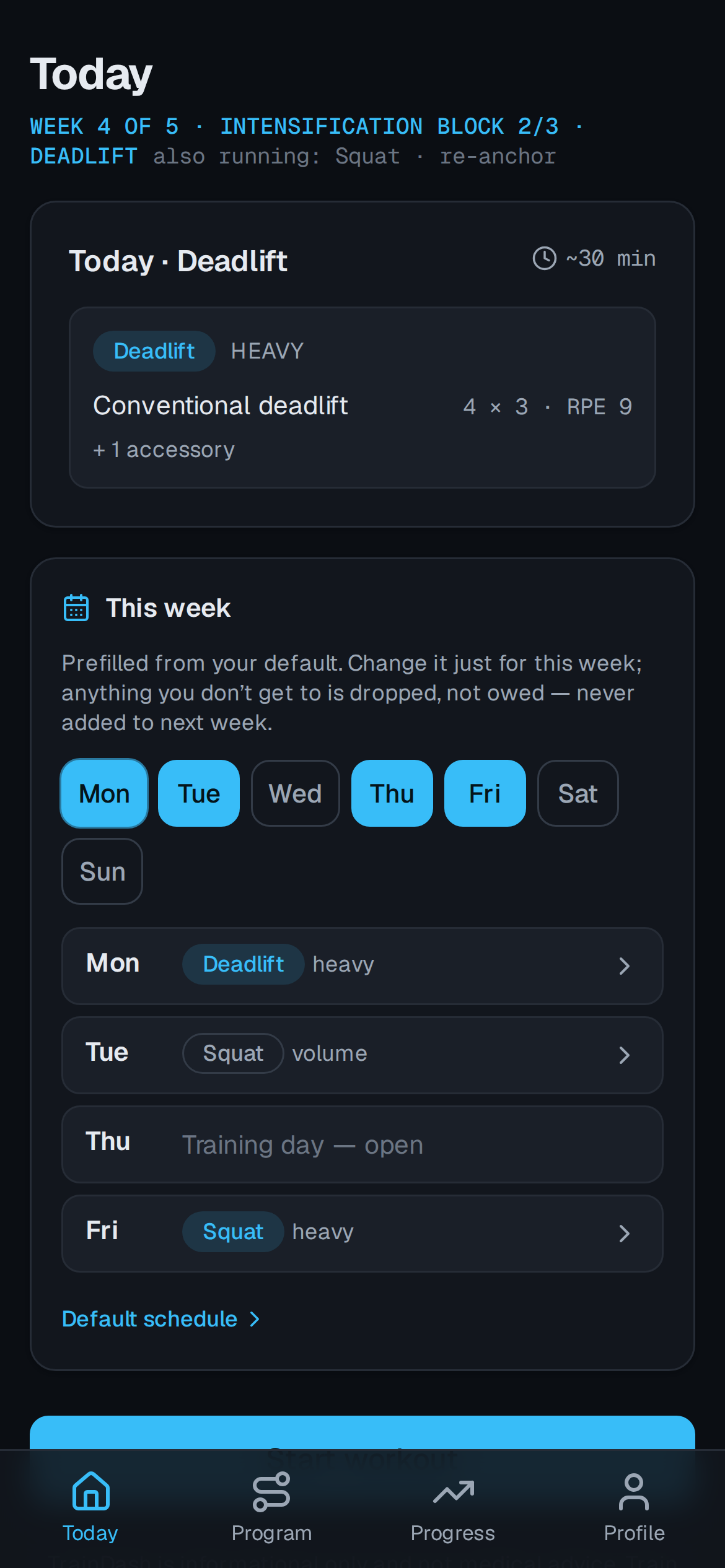
Every strength program is a prediction. Somebody decides today what you will lift in five weeks — how many sets, at what percentage, on which day — and writes it down. Then you get a cold. Work runs long on a Tuesday. Your bench moves faster than anyone guessed and your squat stalls for a month. The prediction was made once, in advance, by someone who could not see any of that.
Most lifters answer this by editing the spreadsheet. That works, and it is also the thing nobody keeps doing: the edit needs a reason, the reason needs a model, and the model is the part a coach charges for.
TrainDash is that model, running in your pocket. It writes a periodized program for squat, bench and deadlift, then argues with its own plan every single session — against what you actually lifted, and against how you actually felt walking in.
Why a static plan stops paying
For your first year under the bar, adding 2.5 kg every session works, and nothing clever beats it. Then it stops. The classic intermediate plateau is not a motivation problem — it is a timescale problem. You have stopped being able to recover from one session to the next, so progress has to be organised over weeks: a stretch where you accumulate work you cannot yet fully recover from, a stretch where the work gets heavy and the volume comes down, a deliberate light week, then a peak.
That is block periodization, and it is well-trodden. The hard part was never the shape. It is that the shape only pays if it is re-fitted to the athlete running it — and re-fitting requires someone to read your log every week and change one thing on purpose.
What TrainDash actually does
It plans in blocks, one lift at a time
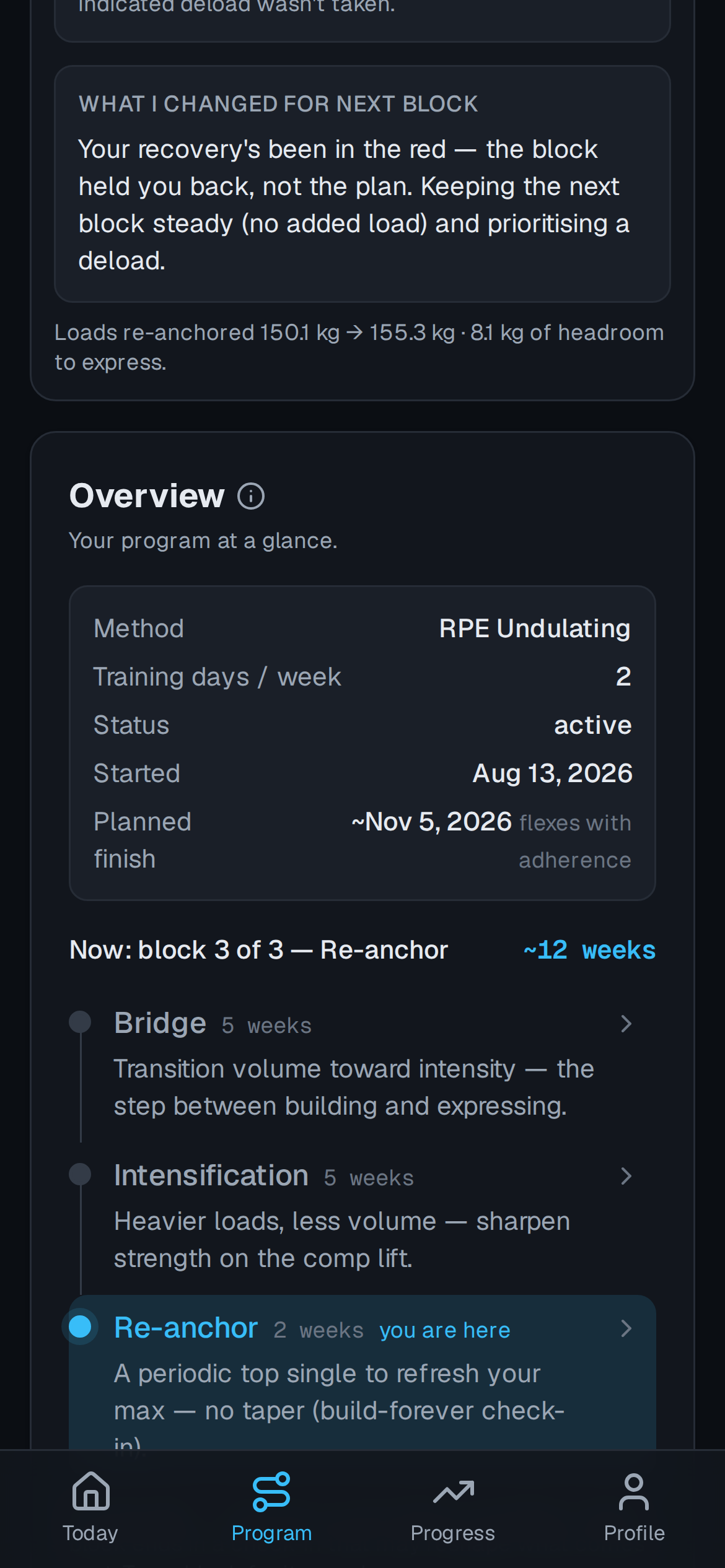
Each of your lifts gets its own arc: an accumulation block to build the work capacity, an intensification block to make it heavy, a deload, and a peak that ends by re-measuring your max. The arc is laid out backwards from whatever date matters to you — a meet, or simply how long you want to train for.
A lift you are genuinely new to does not get any of that. It runs the simple ladder instead — a little more weight each session, back off when you miss, no effort ratings required — and the coach proposes moving it onto blocks when the ladder stops paying. The method is picked per lift, so a lifter can honestly be running both at once: blocks on a squat that has plateaued, the ladder on a deadlift they started last month.
It prices every set off your own numbers
There are no percentages of a number you typed in once. Every prescribed load is computed from a running estimate of your one-rep max for that lift, updated from the sets you log — and then rounded to plates that exist on the bar you actually train with, in kilograms or pounds.
If you have never squatted before, it does not invent a number and pretend. Your first squat session opens with a discovery set: a rep target, an effort target, and no load at all. What you lift there prices the rest of the session.
It reacts, and it tells you why
Three things move a session, and all three come with a sentence.
- The check-in. Fifteen seconds before you start: sleep, soreness, stress, motivation, scored against your own baseline rather than a population average. A bad day trims the session before it costs you the week.
- The set you just did. Log a top set that came up far easier than prescribed and the rest of the session gets heavier. Miss it badly and the back-offs come down.
- The block that just ended. At each boundary it weighs your record — estimated max, effort creeping at the same load, readiness, how much of the plan you actually completed — and tells accumulated fatigue apart from a recovery problem, from too little work, from effort left on the bar. Then it moves one lever, says which, and takes it back if it does not pay.
When the app changes your session, it says so in a sentence you can argue with. No black box, no "trust the algorithm" — the coaching is deterministic rules, grounded in RPE, readiness and volume landmarks, the same heuristics a good coach runs in their head.
That last property is not decoration. A coaching decision you cannot read is a coaching decision you cannot learn from, and the point of training with a coach for a year is that you end the year knowing more than you started it.
What it does when life happens
This is the half most programs never write down.
| What happens | What the plan does |
|---|---|
| You miss a session | It is re-fitted into the week if the week can still hold it — otherwise dropped. Never owed, never crammed into next week. |
| You miss a whole week | The week is a pause, not a failure. Come back and the loads are capped for a session or two while you re-find them. |
| You take a holiday | Declare it and the program plans around it — often by spending the break as the deload it was going to schedule anyway. |
| You move a training day | The week re-lays itself: heavy work spaced, a day carrying two lifts trimmed so it still fits in one session. |
| A knee hurts | Say so. The squat gets lighter or swapped; the bench is untouched. And if what you describe is not a training problem, it says so and points you at a professional instead. |
What it is not
Being clear about the ceiling is part of being trustworthy about the floor.
- It is not an editor for your own program. The coach is opinionated. If you want to run a plan you wrote yourself, log it as free sessions — the in-session coach still prices your work — but the program tab will not become a blank canvas.
- It is not a bodybuilding app. It programs three competition lifts, their variations, and the accessory work that supports them. It counts every set toward each muscle it credits, but the goal it optimises is a total.
- It does not read your watch. Everything it knows, it knows because you logged it or answered it.
- It is not magic, and it is not a model that learned you from a dataset. It is a few thousand lines of explicit rules taken from the strength-training literature, applied to your log.
What is free
The reactive half is free forever: the logger, the check-in and its trend, estimated-1RM tracking, the full volume and recovery analytics, and the in-session coach — which prices any exercise you add, on program or entirely off it. What you pay for is the half that plans ahead of you: the periodized program itself, the block-to-block adaptation, peaking for a date, and planning around a declared break. The full comparison is on the pricing page.
Start with one lift
You do not have to commit to a nineteen-week arc to find out whether this is for you. Set up one lift, train a week, and read what it says at the end of it.
Create a free account — no card, built and hosted in the EU, and your log stays yours on the way out.