
A strength program that argues back.
A static program is a guess made weeks in advance. TrainDash builds you a block-periodized plan — accumulation, intensification, a peak — to break the classic intermediate plateau, and runs simple linear progression on any lift you are still new to. Squat, bench, deadlift, each corrected every session from how you actually perform and feel.
TrainDash opens to new lifters in January 2027. Built in the EU, your data stays in the EU.
How it works
- 01
Tell it where you are
The lifts you want to train, your numbers, your training days, the equipment you actually have. Five minutes, once.
- 02
Train
It hands you today's session: sets, reps, and a target load priced off your own estimated max — plate-aware, in kg or lb.
- 03
It adjusts
Walk in tired and it trims the day; hit an easy top set and it adds weight. Miss a week and it ramps you back. Always with the reason.
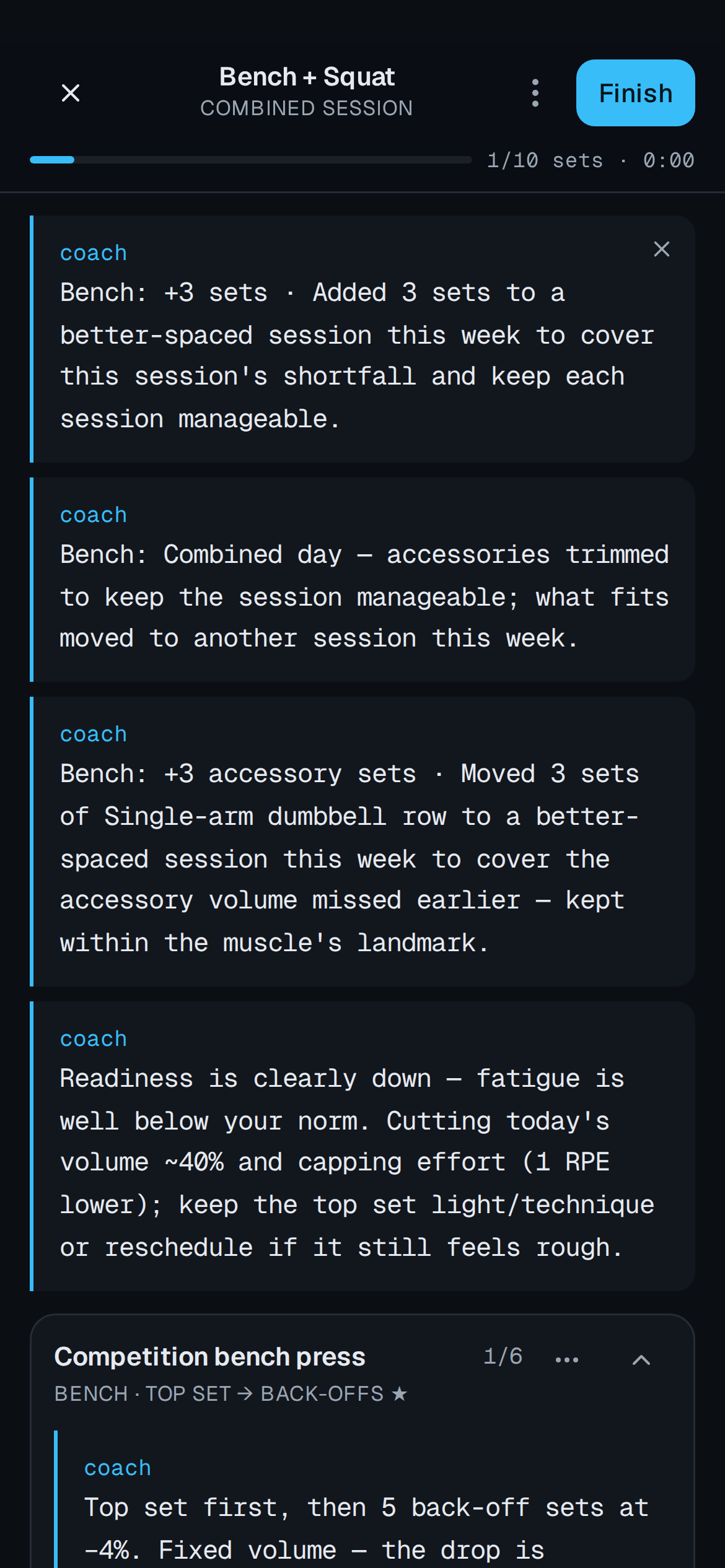
Every adjustment, explained
When TrainDash changes your session, it tells you why — “your readiness is low today, so I cut the back-off sets and kept your top set.” No black box, no “trust the algorithm”. The coaching is deterministic rules you can read, grounded in RPE, readiness, and volume landmarks — the same heuristics a good coach runs in their head.
What you get
Six things a coach does, that a spreadsheet cannot.
Block periodization, lift by lift
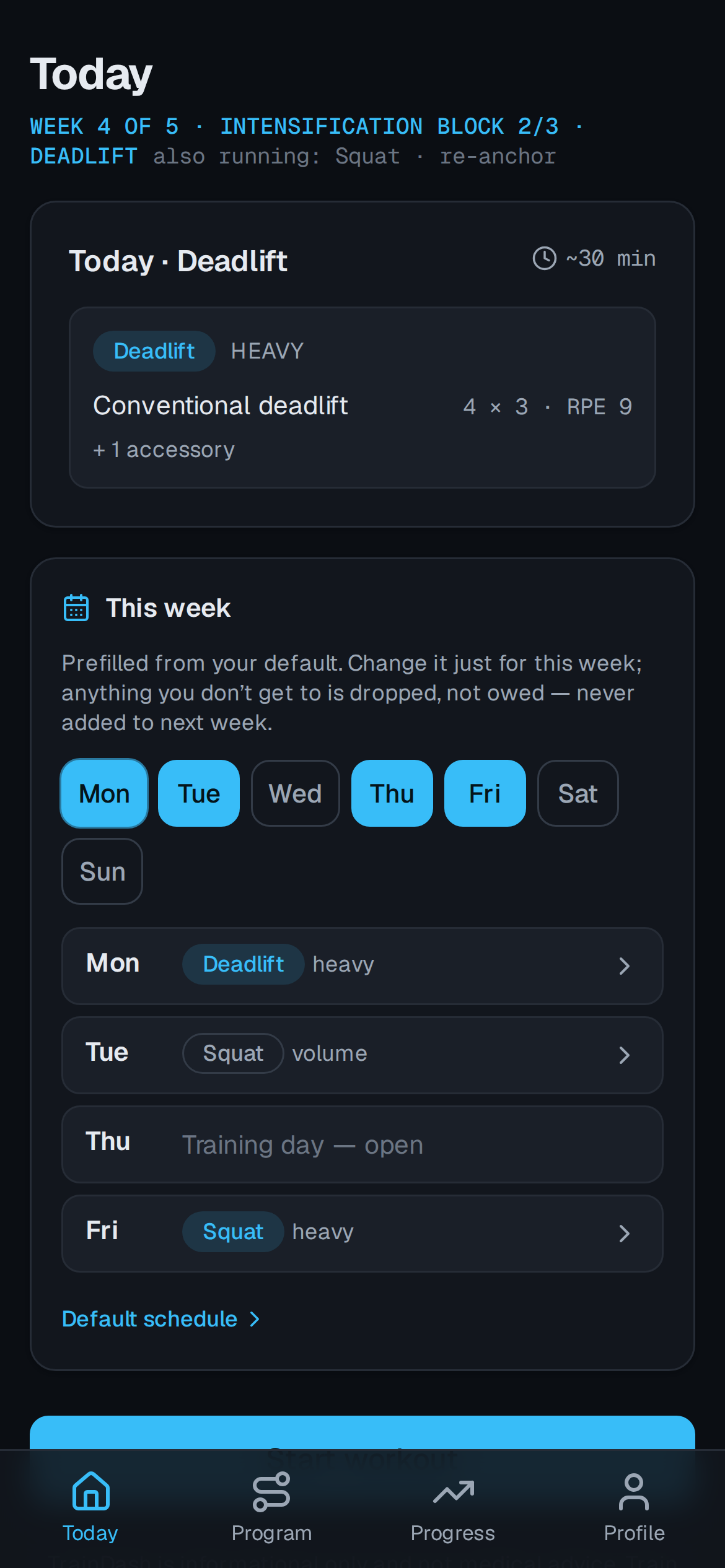
Squat, bench and deadlift each get their own arc: an accumulation block to build the work, an intensification block to make it heavy, a deload, then a peak. A lift you are new to runs the simple ladder instead — a little more weight each session — and the coach moves it onto blocks when that stops paying. One lift can run each way at the same time.
A plan that keeps moving
The program is a starting hypothesis, not a contract. A 15-second check-in scores today against your own baseline and trims the session before it costs you. The week lays itself out on the days you actually train — heavy work spaced, a day carrying two lifts trimmed to fit — and re-fits when you move a day or miss one.
When you stall, it reads the cause first
A stall is never one thing. At each block boundary it weighs your own record — estimated max, effort creeping at the same load, readiness, how much of the plan you actually completed — and tells accumulated fatigue apart from a recovery problem, from too little work, from effort left on the bar. Then it moves one lever: a deload, a lighter set structure, more volume, another session, a push closer to failure. One change, with its reason, taken back if it doesn't pay.
A coach inside every session
Add an exercise the plan never asked for and it comes back priced — sets, reps, a load off your own numbers, one line saying why. Train with no program at all and the same coach runs the whole session: name the kind of day and it composes it, then progresses it week to week. It is the same engine either way, so a freestyle set and a programmed set are handed the same kilograms. Free, forever.
Volume you can actually see
Every set counts twice — toward its lift's weekly volume, and toward each muscle it credits — and both are drawn against your minimum effective, adaptive and maximum recoverable set counts, so you can see what is still under its floor and what is brushing its ceiling. Plus weekly load, recovery, your capacity against your expressed max, and how close the coach's predicted loads have been. All of it free.
Life happens; the plan absorbs it
Miss a day, cut a week short, declare a holiday: the work is re-fitted around it or honestly dropped — never crammed into next week, never owed. Say a knee hurts and the session works around it: lighter there, a swap, everything unaffected exactly as planned. And it knows when to say “see a professional”.
See it working
From the check-in to the last set, and everything the plan learns from it.
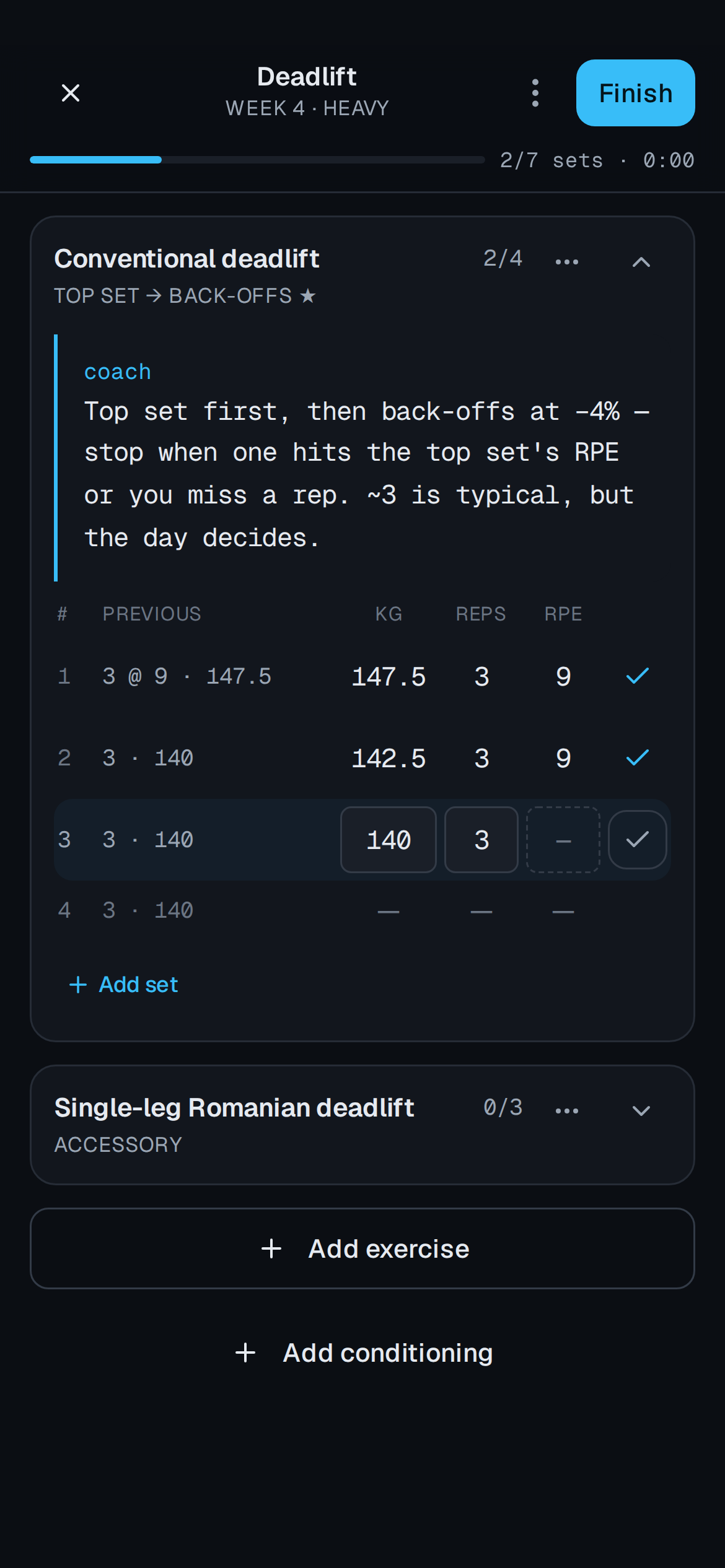
Log the session — and the coach talks back between sets.
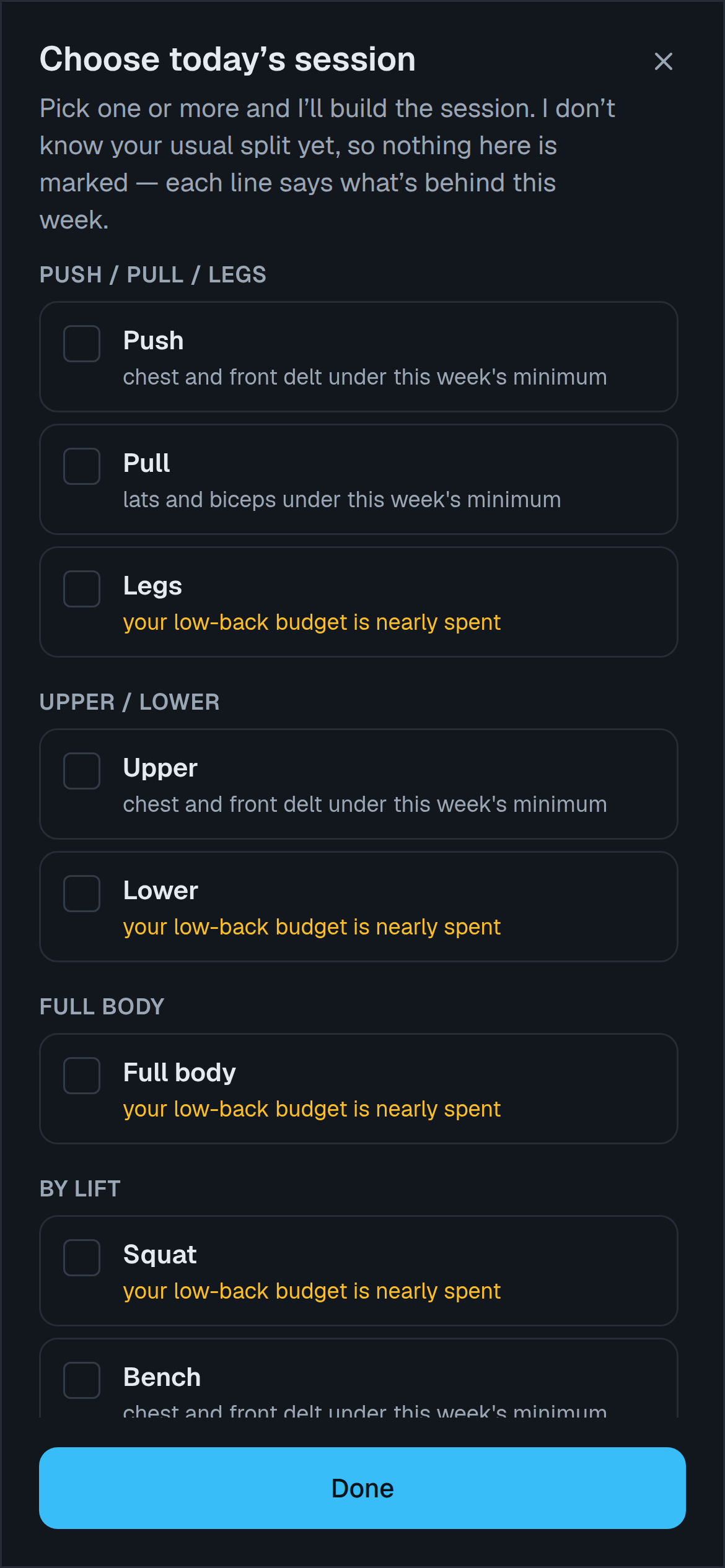
Or tell it what today is about, and let it build the session.
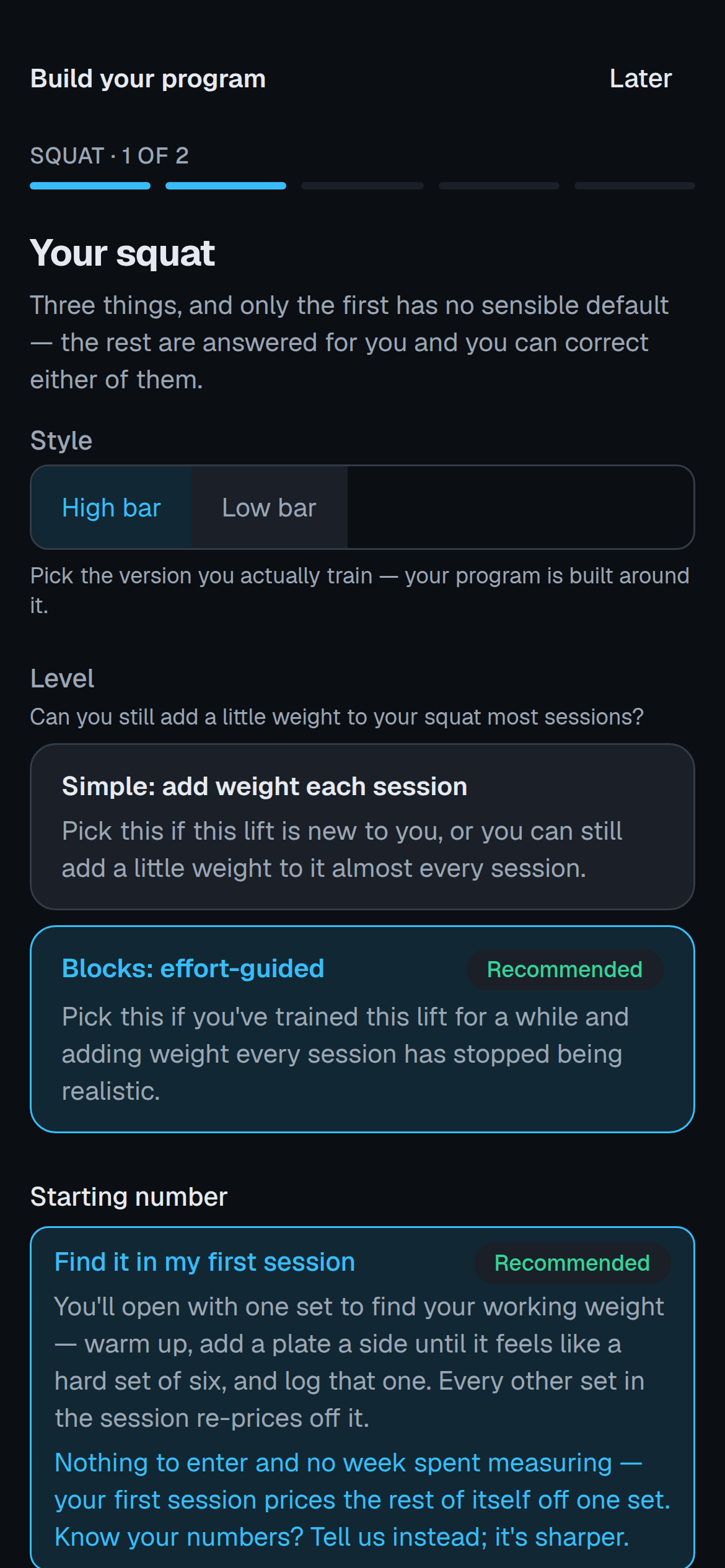
Each lift is set up once: its style, its method, how it starts.
Today, and the week around it.
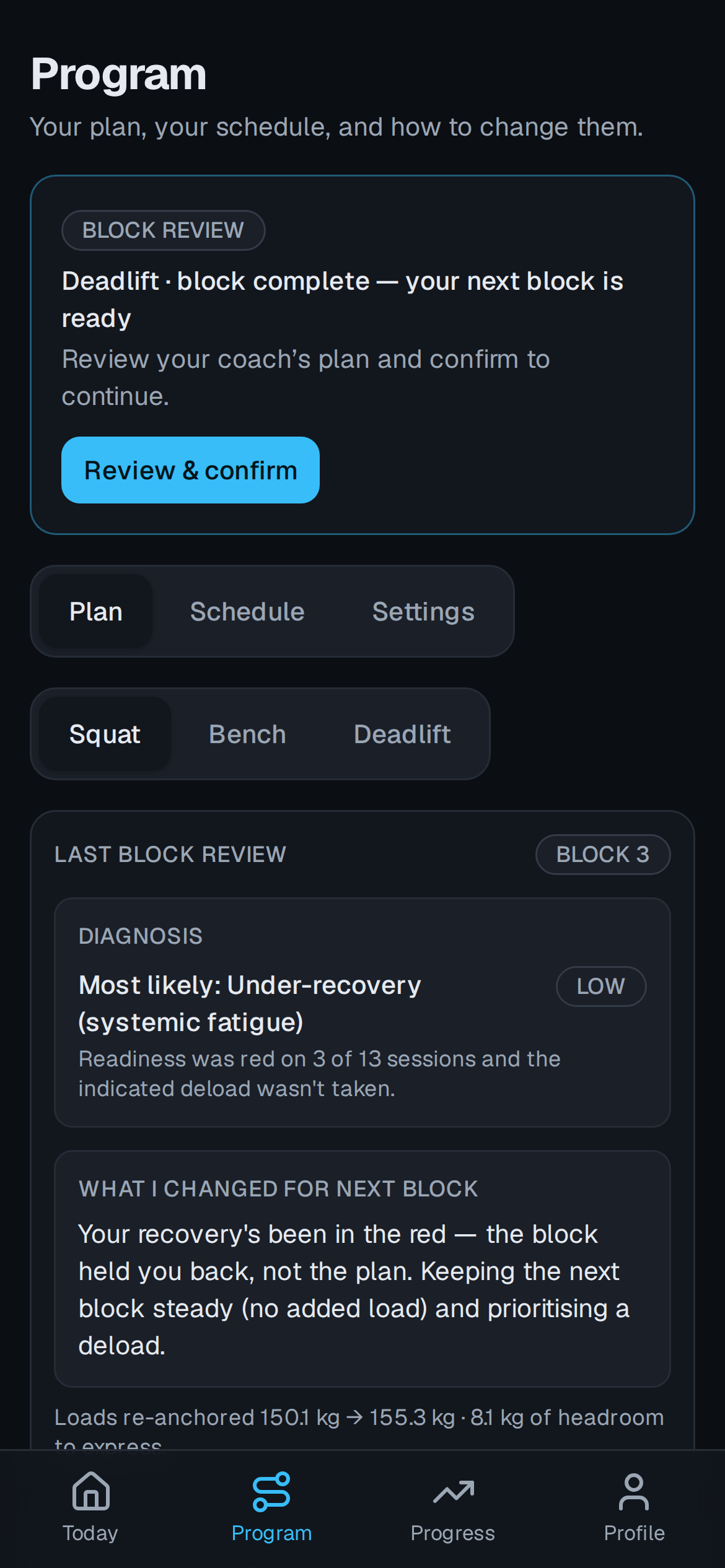
At the end of a block, the coach reads it back and proposes the next.
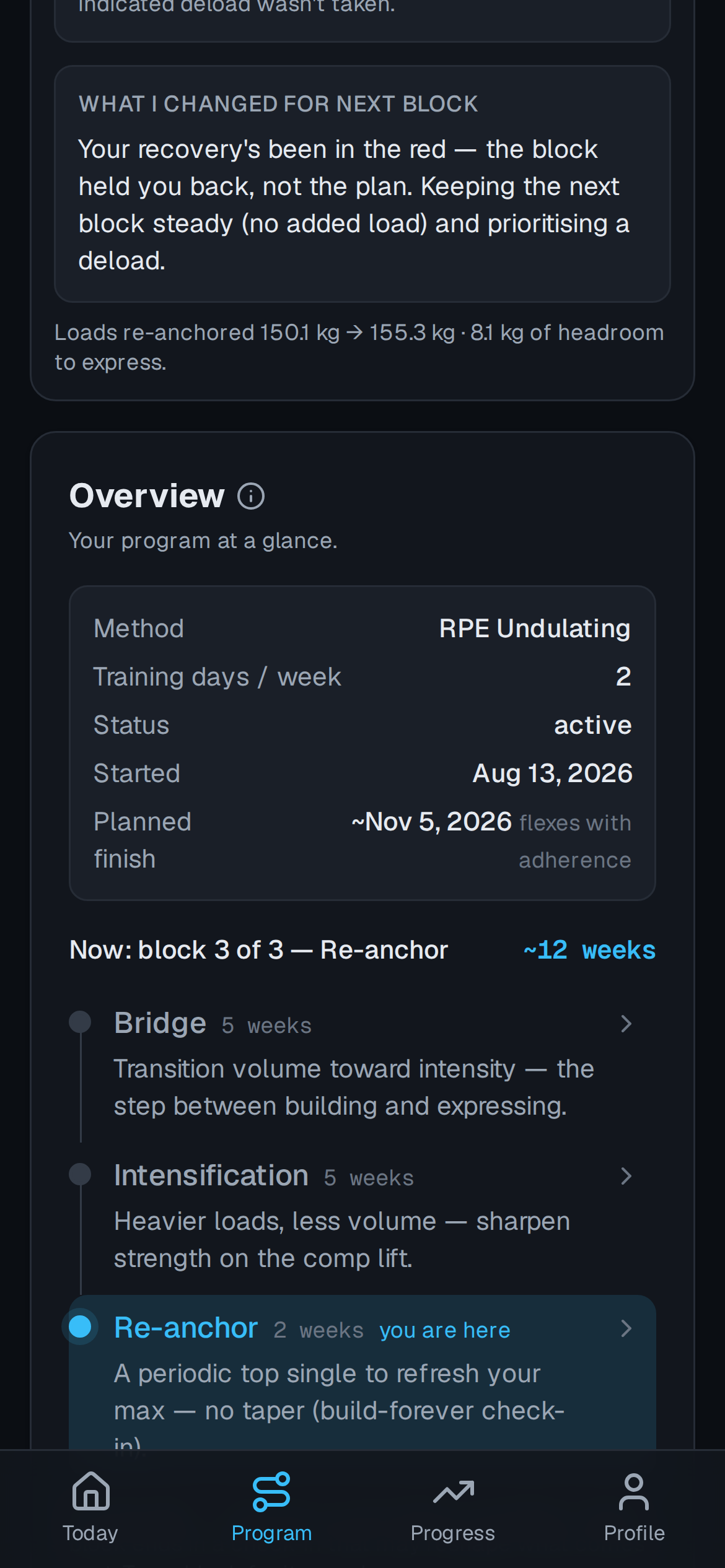
The whole arc, phase by phase, with today's place in it.
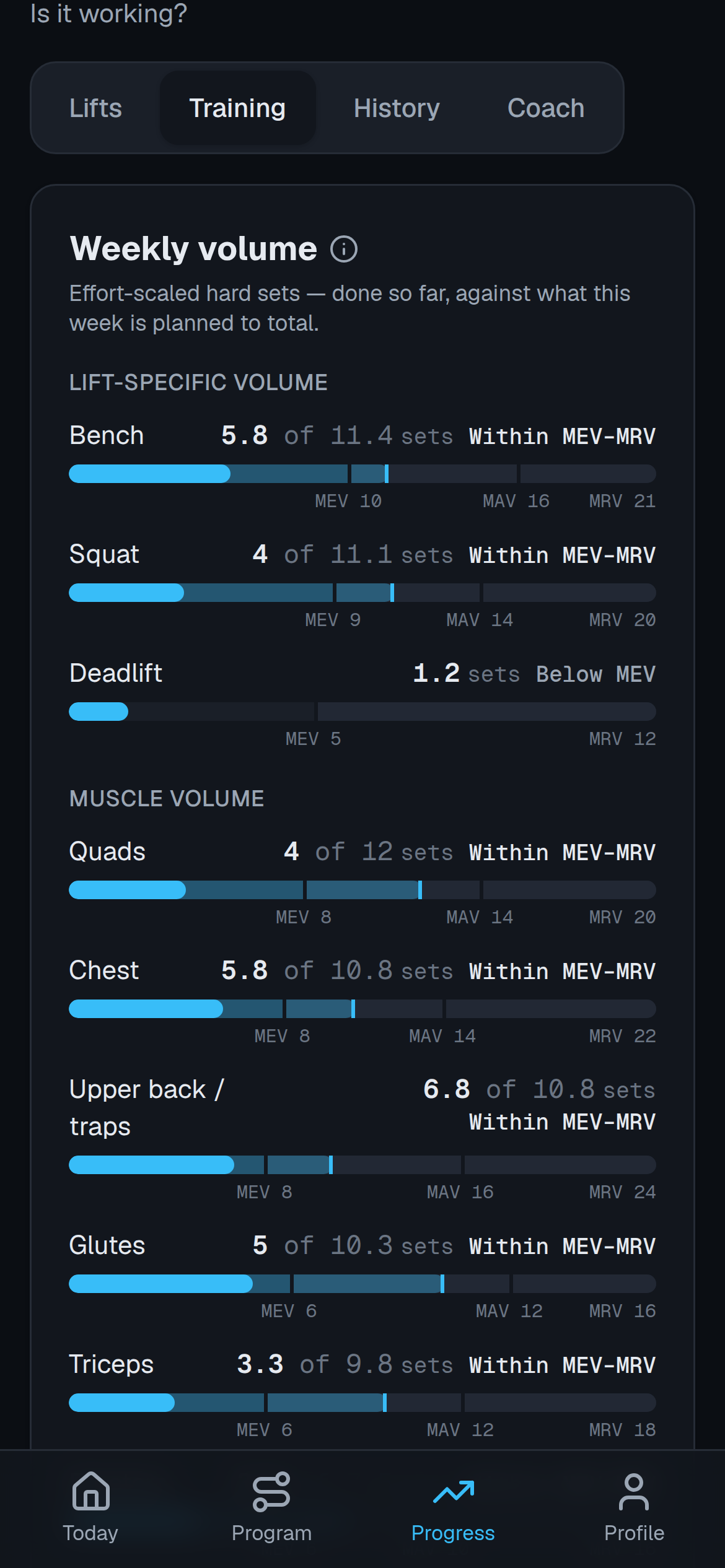
Your week's volume against your own landmarks — on every account.
You don't have to be a powerlifter
The program is built for squat, bench and deadlift, and stays that way. The Session Coach isn't: it coaches the session you actually walked in to do, whatever that is, and it is free with or without a program running. For a lot of lifters it is the whole product.
What it will not do without Pro is plan ahead of you — no blocks written in advance, no deload on the calendar, no peak, no next week. It coaches the session in front of it. If you train by feel and simply want the numbers to be right, that may be all you ever need.
Pick the kind of day
Push, Pull, Legs, Upper, Lower, Full body, one muscle group, or a single lift. The coach composes it — one movement per pattern rather than three rows for the same muscle, the muscles nothing else on the sheet covers first, and the size of a real training day instead of a wish list. Which split you run is read off your own logged sessions, not asked. Every row is a suggestion: change it, drop it, or add your own.
Every set priced, with the reason
Sets, reps and a load off your own estimated max and your own last outing on that movement — rounded to the plates, the dumbbells or the pins you actually have, with one line saying why. Accessories run a double progression: reach the top of the rep range on every set and the weight goes up, by a step your gym can really build.
A week and a progression, not just today
Your sets are counted per muscle and per pattern against your own minimum-effective, adaptive and maximum-recoverable targets, so the coach knows this is your fourth hard chest session of the week and doses accordingly. And your main lifts walk a rolling arc: the top set gets harder across the weeks, the rep scheme rotates when a run has done its work, and a light week arrives when you have earned one.
Free to train. Pay for the program.
The reactive half is free and stays free: the logger, readiness, your estimated max, the Session Coach, and the whole Progress tab — your weekly volume per lift and per muscle included.
Free
€0
Everything you need to train, track and read your own numbers — and a coach that will compose the session, price every set and keep it progressing.
- Workout logger — sets, RPE, rest timer, PRs
- Session Coach — pick the kind of day you're training and it composes the session, prices every set with its reason, and progresses it week to week
- Daily readiness check-in + trend
Pro
€9.99/month
The weeks and months ahead, laid out: block periodization, and everything else that runs ahead of you.
- Periodized program per lift — blocks, deloads and a peak, laid out weeks ahead on the days you actually train
- Block-to-block adaptation — it reads the block you just finished, names what held you back, and reshapes the next one
- Peaking — build to a meet or test date, ending on a taper and a re-tested max
Questions, answered
What is TrainDash, in one paragraph?
TrainDash is a strength coach for the three powerlifting lifts. It builds you a periodized program — volume blocks, intensity blocks, deloads — and then adjusts it every session based on how you perform and how you feel, the way a coach would. Every adjustment comes with its reason.
I don't know RPE — can I still use it?
No effort rating required to start. If you're newer to training you begin on a simple made-your-reps / missed-your-reps progression. The app still asks how hard sets felt, so you learn RPE as you go, and it moves you to RPE-driven programming when your numbers show you're ready.
What exactly is free?
Everything reactive: the workout logger, the daily readiness check-in and its trend, estimated-1RM tracking per lift, the whole Progress tab — weekly volume per lift and per muscle against MEV/MAV/MRV, load monitoring, recovery, relative strength — and the Session Coach, which is more than a suggestion box: name the kind of day you're training and it composes the session, prices every set with its reason, doses it against your week, and progresses your lifts from one week to the next. Off-program, forever. So is your data: export and account deletion are never paid features, and neither is the pain safety screening.
Pro is the proactive half — the three things the coach above deliberately never does. A horizon: blocks, deloads and a peak written weeks ahead and laid on the days you train, next week included. A terminus: a taper and a re-tested max on a date you name. And a memory across blocks: it reads the block you finished, names what held you back, and reshapes the next one. Planned time off, pain-aware coaching and the conditioning library come with it. The full comparison is on the pricing page.
Where is my data stored?
In the EU. The app is built and hosted in Europe, and your training log, your readiness answers and your account live on EU infrastructure — they are not shipped elsewhere for processing.
Nothing about your training is sold, shared or used to advertise to you, and the marketing site you are reading sets no cookies at all.